
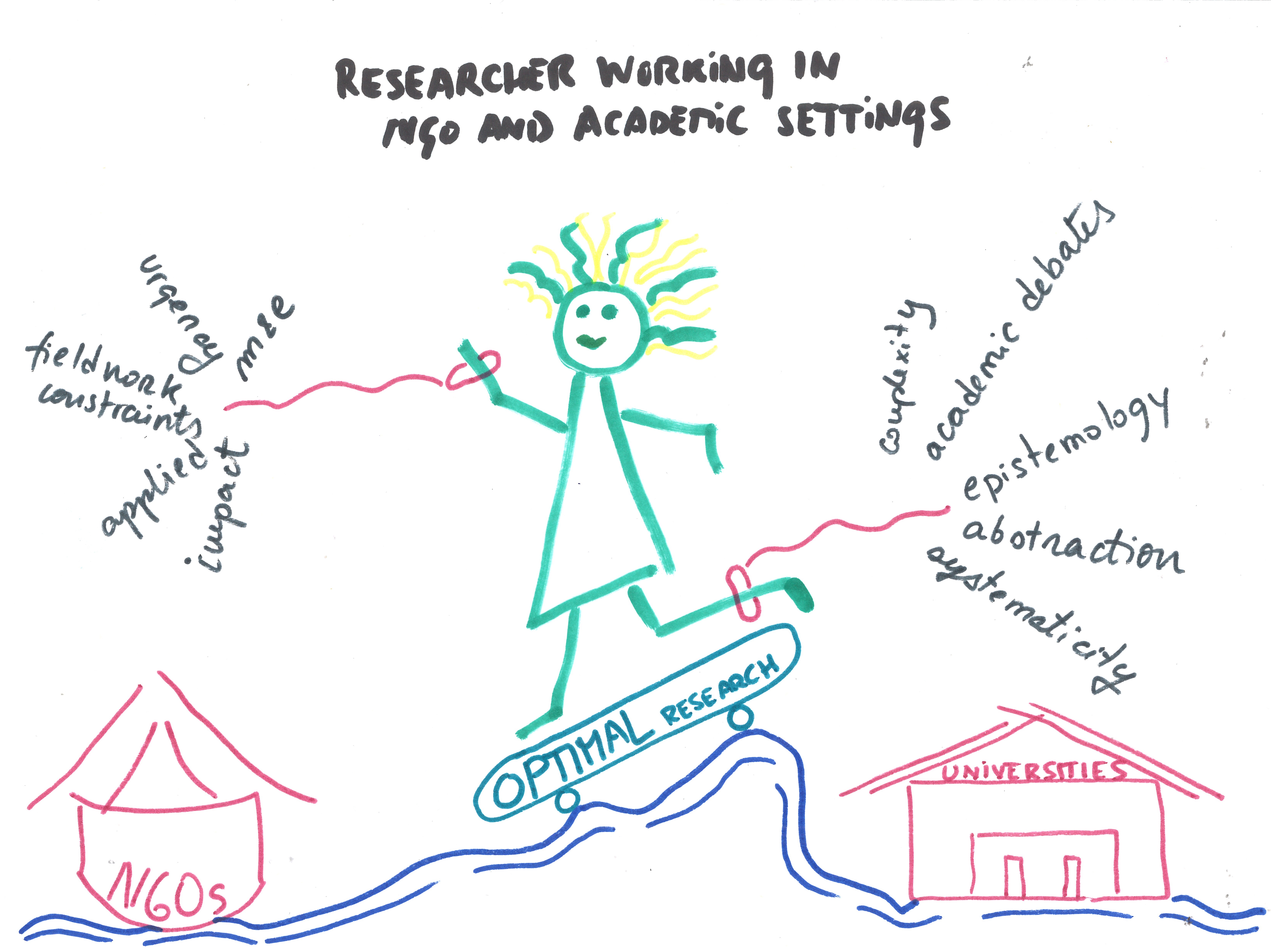
The Rethinking Research Partnerships process involved a series of seminars/workshops bringing together a group of UK staff from INGOs and universities to explore and learn from their experiences in research partnerships. Two years on, and after a lot of discussion and analysis we have pulled together the insights and learnings into an exciting new publication: the ‘Rethinking Research Partnerships: discussion guide and toolkit’.
DOWNLOAD THE GUIDE AT CHRISTIAN AID HERE
This publication is aimed at anyone thinking about, or already participating in, an academic-practitioner research collaboration; whether you are an academic or practitioner, or indeed a broker or funder of research partnerships. It raises the critical questions that should be considered within any research partnership. It provides different ways of exploring and analysing the external context and internal dynamics – linking the issue of who is participating and how, to the types of knowledge that are privileged and the types of evidence used, produced and valued in the partnership (you can read more on some of these issues in Chik Collin’s blog here). The guide offers ways of challenging traditional assumptions, and of creating space to ask how research processes could be designed, implemented, analysed and communicated in more inclusive ways with greater impact. The materials were produced collaboratively, and the guide itself is intended to be interactive, adaptable and useable in a variety of contexts.The seminars were rich in learning and discussion, and a huge range of issues are covered in the publication, but here are five issues to consider in research partnerships:
- Take care of the relationship: each partner will have their own motivations, expectations and assumptions as they enter a partnership – it is important to surface these and be clear about what they are, and to monitor them over the life of the partnership to ensure that they still hold, or adapt practice if need be.
- Production of ‘evidence’ is key: across the INGO sector there are increasing demands for ‘rigorous evidence’ and for academics to ensure their research has ‘impact’; these drivers contribute to the initial interest in partnership, but also create many of the assumptions that shape partnerships – such as what ‘good evidence’ looks like and whose responsibility it is to design research, collect data, analyse findings and create outputs. There can be many good reasons for challenging these default roles, including opening up space for different types of knowledge and evidence to be created, building skills and capacity in both types of institution, or because of a specific ambition to challenge wider assumptions about evidence and shift power.Read Jill Russell’s reflections from a practitioner’s perspective
- The impact of context: all the partnerships studied in the series were between UK universities and INGOs headquartered in the UK; this was both a limitation and a benefit of the series. It enabled us to think through the specific (funding and policy) drivers in the UK context – and really unpack how the external environment created interests and agendas; shaped expectations of what evidence would be produced in partnership and who the audience for this evidence should be. We noted that, while context is important response to the context is not pre-determined. In some of the case studies the partnership evolved precisely to challenge context expectations, while in others, decisions were dominated by a need to service particular trends and priorities in the current context. Read Kate Gooding’s Blog on Contexts that encourage partnerships
- Partnerships come in all shapes and sizes: from the informal links between two like-minded individuals, to large scale funded institutional collaborations. However, whatever the size and scale, partnership working relies on individual connections, shared visions, personal relationships and an individual in each institution committed to making things work. These people will often work as ‘partnership brokers’ able to listen and translate across organisational boundaries, understanding the language and pressures of both institutions, and smoothing the way for partnerships to flourish. Read Flora Cornish’s blog on ‘Partnerships’ or ‘Relationships’?
- ‘Productive Tensions’ make partnership working worthwhile: Much of the discussion of the RRP series focused on the challenges of partnership, but productive tensions, arising precisely because those involved are different are a key asset. They bring together different ways of working, of thinking about issues, of skills, of relationships and interests. These differences are what enable space to open up for new ways of thinking and doing, for partners to be creative and explore alternatives. Valuing difference is key to enabling partnerships to be more than the sum of their parts. Read Shelly Makleff’s blog on Reflections on establishing and sustaining partnership
The publication is a point on a longer journey of understanding the potential of academic-INGO collaborations; and as such it will be great to hear back from you as you use the guide. I hope it will inspire you to reflect on your research partnership experiences; to explore and potentially challenge your own assumptions and feel confident in experimenting – including viewing research collaborations as a space doing things differently; and considering how best to development inclusive, impactful evidence for international development.
….a version of this blog is also cross-posted at Christian Aid here
 .
. 
Leave a comment